Every Word From P2 to P5 — Locked Into Long-Term Memory Before PSLE
11,790 flashcards covering the complete P2 through P5 MOE Chinese syllabus. Standard and Higher Chinese. Three card types per word — reading, writing, and sentence comprehension — with native audio, stroke order animations, pinyin, and English translations. The same spaced repetition system that got your child through P1, now scaled across the years that matter most for PSLE.
For families who've seen spaced repetition work and want the complete set through to PSLE. You don't need to know Chinese to use this.
Why P2-P5 Is Where Most Children Fall Behind
P1 is manageable — the vocabulary is basic, the characters are simple, and the words overlap with what children hear at home. From P2 onwards, everything changes. The word count nearly doubles each year. Characters become more complex. The gap between what school teaches and what your child retains starts widening fast.
By P4 and P5, your child is expected to read passages, write compositions, and speak in oral exams using vocabulary from every previous year. Children who crammed and forgot in P2 and P3 are now building on a foundation full of holes. PSLE doesn't test what your child crammed last week — it tests what they actually know.
This is exactly the problem spaced repetition was designed to solve. Every word your child learns stays learned. When PSLE arrives, they're not re-memorising 4 years of vocabulary in a panic — they already know it.
What's Inside the P2-P5 Set
- P2: 2,835 cards (945 words x 3 card types)
- P3: 2,484 cards (828 words x 3 card types)
- P4: 2,637 cards (879 words x 3 card types)
- P5: 2,340 cards (780 words x 3 card types)
Each level is organised lesson-by-lesson to match exactly what your child learns in school. Both Standard and Higher Chinese vocabulary included, clearly labelled. Already updated for MOE's new 2024 syllabus, with further updates added within weeks as MOE releases each level.
PSLE: Why Vocabulary Is the Difference Between AL3 and AL1
Under the AL scoring system, the difference between AL1 (90+ marks) and AL2 (85-89 marks) is just 5 marks. In Chinese composition and oral — where marking is subjective — losing 5 marks is easy.
Vocabulary is the foundation of everything: comprehension speed, composition richness, oral confidence. A child who genuinely knows every word reads passages faster, writes with more range, and speaks with less hesitation. That's the difference between AL3 and AL1.
And from 2026, scoring AL1 or AL2 in Standard Chinese qualifies your child for Higher Chinese in secondary school — regardless of their overall PSLE score. Higher Chinese is the tie-breaker for SAP schools like Nanyang Girls, Hwa Chong, and Tao Nan. A strong Chinese vocabulary doesn't just help Chinese — it opens doors to the schools you're aiming for.
3 Card Types Per Word — Real Fluency, Not Shallow Recognition
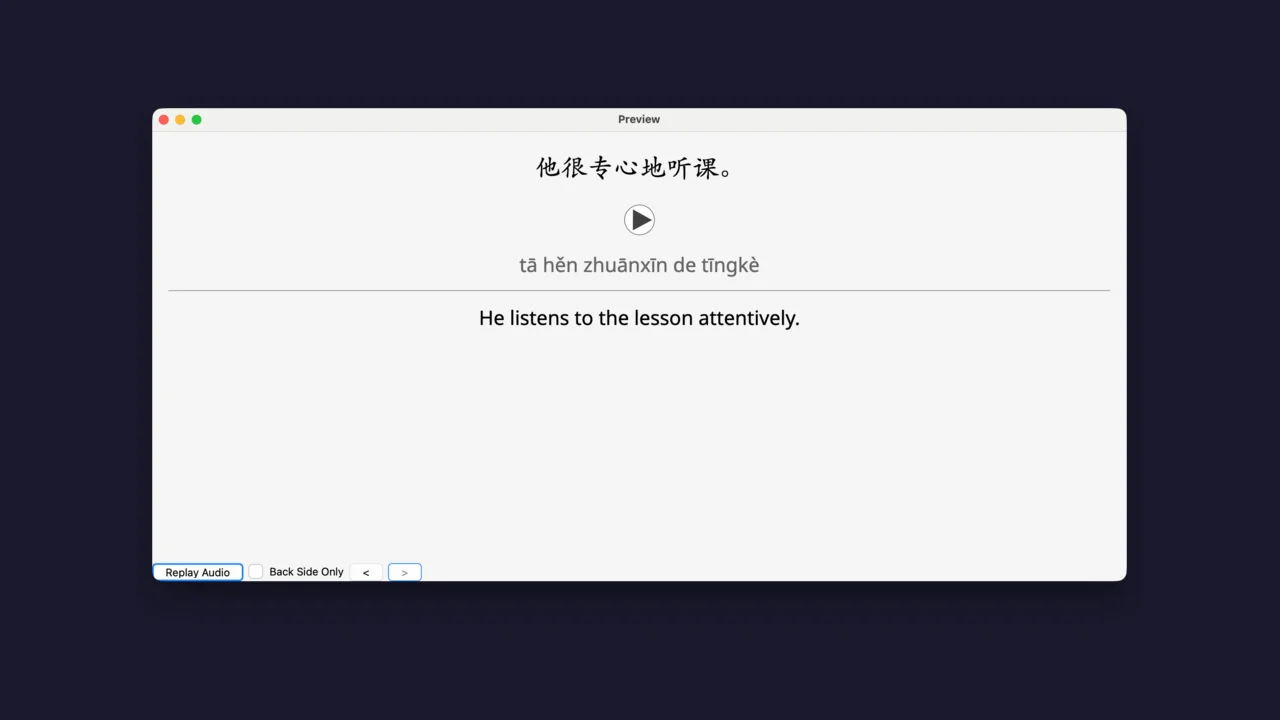
Most flashcards only test one thing: "see the word, recall the meaning." That's not enough for PSLE. Your child needs to read, write, AND understand each word in context. This deck tests all three:
- Recognition: See the characters → recall the pinyin and meaning
- Writing: See a sentence with a pinyin gap → write the correct characters
- Production: Read a full sentence → understand the word in context with audio
This three-way testing builds the kind of deep, automatic fluency that shows up in composition vocabulary, comprehension speed, and oral confidence. No other Chinese flashcard deck for the Singapore syllabus does this.
Works Even If You Don't Speak Chinese
Every card includes native audio pronunciation, stroke order animations, pinyin, and English translations. The algorithm handles the scheduling. You don't need to read or speak Chinese at all. Most families in our WhatsApp community are English-speaking households — you're not figuring this out alone.
Everything You Get
- 11,790 flashcards covering every P2-P5 Standard and Higher Chinese word
- Native audio pronunciation on every card
- Stroke order animations for every character
- English translations and pinyin on every card
- WhatsApp community access — a private parent group with custom bonus decks every Saturday
- 10-email setup sequence — most parents are up and running in 10 minutes
- Lifetime updates — updated within weeks as MOE releases new syllabus content
- Family use — siblings can each have their own profile
What Parents Say
"The cards have been beneficial and helps him to remember his words beyond just the usual 听写. He also got into Higher Chinese as well!"
— Singapore Parent
"I was trying to make my own flashcards for my child to prepare for PSLE, and it is VERY time consuming. Joshua must have spent days and even months of work to compile 6 years of Chinese worth of vocabulary list into flashcards. Extremely grateful for this!"
— Parent preparing for PSLE
The Real Cost of Staying on the Treadmill
- Chinese tuition, one child, P1-P6: $14,400 - $28,800
- Chinese tuition, two children: $28,800 - $57,600
- Chinese learning apps, one child, P1-P6: $720 - $2,160
- This deck + P1 deck, entire family, P1-P5: $1,098 total
$999 covers 4 full years of vocabulary — P2 through P5 — for your entire family. That's less than 5 months of tuition for a system that builds permanent retention instead of temporary cramming.
30-Day Money-Back Guarantee
Use the deck with your child for 30 days. Do the 10 minutes a day. If your child doesn't retain more words in a month than they normally keep after a 听写 cycle — full refund, no questions asked.
PSLE doesn't wait. Every term your child spends in the memorise-test-forget cycle is another term of vocabulary they'll need to re-learn later. Get the P2-P5 set now — the words they learn today stay learned through PSLE and beyond.