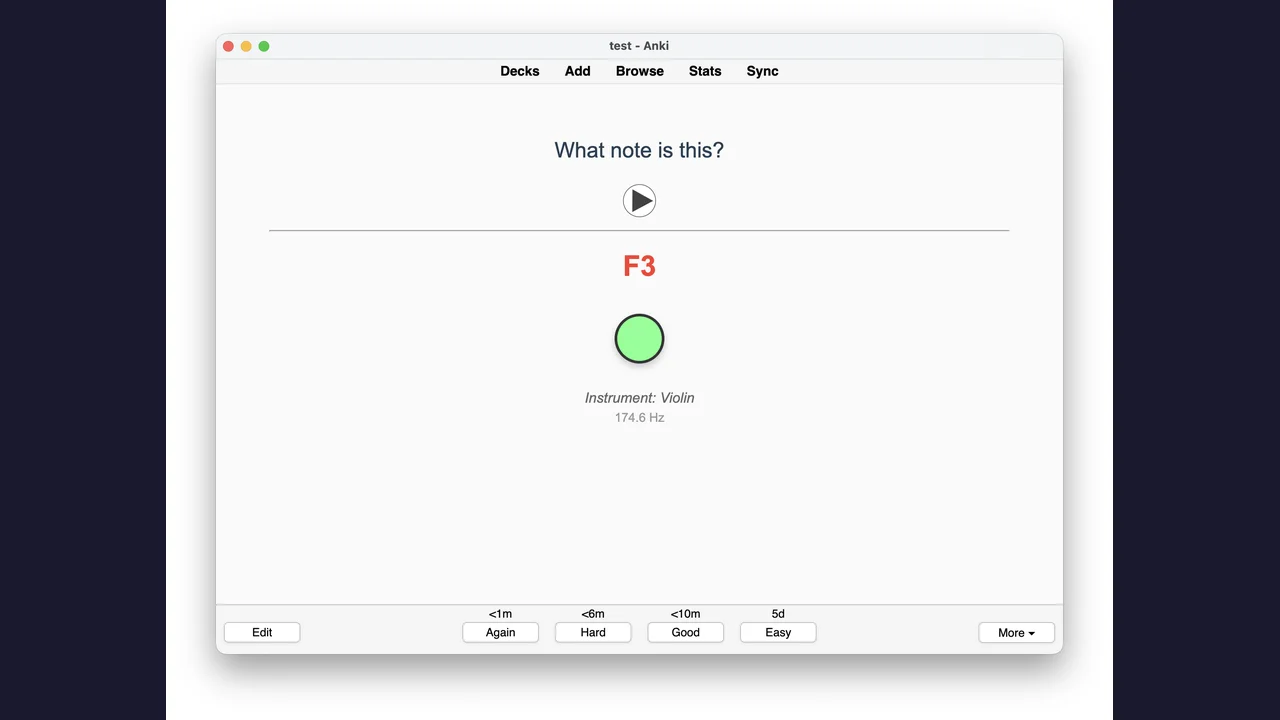
The Research-Based Perfect Pitch Training System — Free Anki Deck
324 training cards with 466 professional audio files across 5 instruments. Based on University of Chicago research that achieved a 14% success rate in controlled studies — compared to less than 1% for traditional methods. The key innovation: cross-timbre training that prevents the fatal flaw in every other perfect pitch program.
Free download. Works on all devices. 15-20 minutes of daily practice.
Why Most Perfect Pitch Programs Fail
Traditional training methods have a fatal flaw: they teach you to recognise notes on one instrument. You learn that "this sound" is C — but only on piano. Hear C on guitar, and you're lost. That's not perfect pitch. That's timbre-pitch association, and it's why most training programs produce zero results.
The research solution is cross-timbre training: learn every pitch on every instrument, so your brain learns to identify the pitch itself — regardless of what's producing the sound. This deck implements exactly that approach.
What You Get
324 professional training cards:
- 208 Note Recognition Cards — every note across 5 instruments (Piano, Guitar, Violin, Flute, Pure Sine Tones)
- 105 Chord Recognition Cards — complete harmonic training with arpeggio breakdowns
- 11 Production Cards — name, sing, verify. Active internal pitch memory development.
466 high-quality MP3 audio files — professional MIDI synthesis at 44.1kHz. Consistent volume across all instruments for fair comparison. 25MB total, optimised for mobile devices.
5-Phase Learning Progression
Phase 1 — Foundation (Week 1-2): 12 pure sine tone cards. Build your scientific pitch reference.
Filter: tag:'Notes' AND tag:'Basic' AND tag:'Sine'
Phase 2 — Cross-Timbre Recognition (Week 2-4): 123 cards across all instruments. Same pitches, different timbres — your brain stops associating pitch with instrument.
Filter: tag:'Notes' AND tag:'Basic'
Phase 3 — Production Training (Week 3-5): 11 cards where you sing or hum the note, then verify with piano. Active internal pitch memory.
Filter: tag:'Notes' AND tag:'Production'
Phase 4 — Harmonic Training (Week 4-8): 15 I-IV-V progression cards with arpeggio breakdowns.
Filter: tag:'Chords' AND tag:'Beginner'
Phase 5 — Advanced (Month 2+): Add tag:'Sharps-Flats' for chromatic notes. Progress through tag:'Basic' and tag:'Extended' chords. Mix instruments randomly.
What Success Looks Like
Month 1: Recognise basic notes (C-B) in sine tones. Begin cross-timbre recognition.
Month 3: Identify all natural notes across all timbres. Recognise basic chord progressions.
Month 6: Full chromatic recognition including sharps and flats. Consistent production accuracy.
Month 12: Instant recognition regardless of instrument. True absolute pitch in real-world scenarios.
The Science Behind It
Most people think perfect pitch is an innate gift. Research shows otherwise. The University of Chicago studies demonstrated that with the right training protocol — cross-timbre exposure, production training, and spaced repetition — adults can develop pitch recognition abilities that were previously thought to be fixed in childhood.
This deck implements the full research protocol: every note on every instrument, bidirectional training (recognition + production), extended range (C3-C7), and a smart tag system for progressive difficulty. Perfect pitch isn't a gift — it's a skill.
Get the Deck — Free
Enter your email below and the deck downloads immediately. You'll also receive tips on effective practice routines and how to track your progress through each phase.
Recommended Anki Settings
- New cards per day: Start with 5, max 15
- Learning steps: 1m 10m (short for pitch memory)
- Graduating interval: 1 day
- Easy interval: 4 days
- Maximum interval: 30 days (pitch memory needs frequent reinforcement)
Use good headphones or quality speakers. Set a consistent volume for all practice sessions. A quiet environment is essential for pitch discrimination — 15-20 minutes of focused daily practice beats a 2-hour weekend session every time.
Critical Success Factors
Do: Practice daily (consistency is everything). Focus on pitch, ignore timbre. Use production cards. Start with sine tones. Graduate systematically.
Don't: Skip production training. Practice only one instrument. Rush to chromatic notes before mastering naturals. Ignore chord training. Practice when tired — pitch discrimination requires focus.