Your Child Remembers Every Chinese Word — Not Just Until Friday's 听写
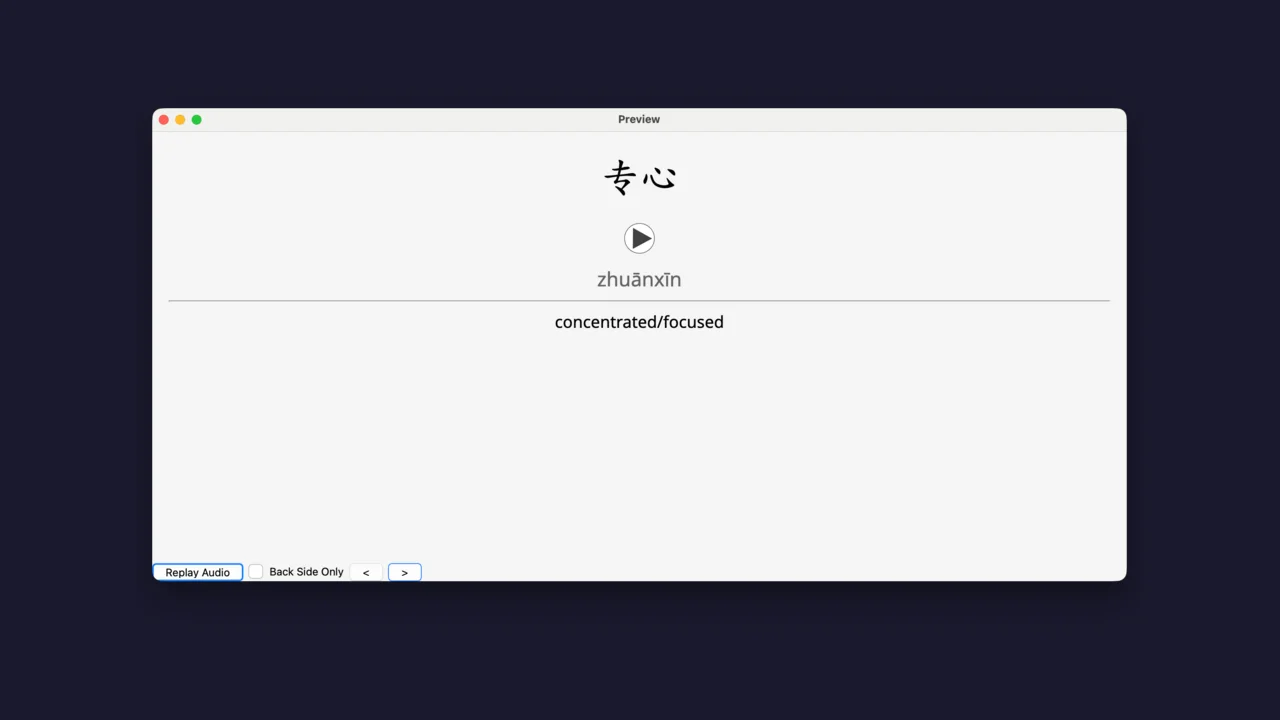
2,421 flashcards covering every P1 word in the MOE Chinese syllabus. Three card types per word — reading, writing, and sentence comprehension — with native audio, stroke order animations, pinyin, and English translations. Built on spaced repetition: the same science medical students use to memorise thousands of facts.
Designed for English-speaking Singapore families. You don't need to know Chinese to use this with your child.
You Already Know This Isn't Working
Have you ever scanned a 听写 word list with your phone camera because you couldn't read the characters? Have you Googled each word one by one just to hear the pronunciation, then tried to test your child on words you can't say properly yourself?
Have you watched your child pass Friday's 听写 — then realised two weeks later they've forgotten almost everything?
You're not alone. Over 60% of Singapore's Chinese families now speak predominantly English at home. For most of our kids, Mandarin isn't a "mother tongue" — it's closer to a foreign language. The system — 听写 drills, tuition, worksheets — was built on the assumption that someone at home speaks Chinese fluently. If you've felt guilty about not being able to help with Chinese, that guilt isn't yours to carry. The system wasn't designed for your family's reality.
You've Probably Already Tried to Fix This
Most families try tuition first. At $200-400 a month — maybe $600+ at the bigger centres — that's $14,400 to $28,800 per child over 6 years.
But tuition uses the same drill-and-forget method as school, just more of it. Upper primary centres teach composition "templates" — pre-memorised paragraphs and stock idioms your child sprinkles into essays regardless of context. It scores marks, but it's not real fluency. The words still don't stick.
Maybe you've tried apps — Du Chinese, HelloChinese, LingoAce. They teach generic Mandarin vocabulary, not what your child actually needs for school. Or you've tried making your own flashcards — hours of work, inconsistent use, and no system for when to review what.
None of these fix the core problem: without properly timed review, the brain forgets.
The Only Method That Solves the Forgetting Problem
Spaced repetition has been proven across 140 years of cognitive science, from Ebbinghaus's original memory experiments to modern studies at universities like MIT and Cambridge. It works by showing each word right before your child would forget it.
See 花 today → review in 3 days → review in 1 week → review in 3 weeks → review in 2 months
Each successful recall doubles the interval. Words move from short-term cramming to genuine long-term memory. Without review, your child forgets 80% within two weeks. With spaced repetition, they retain 90%+ after six months. Same words. Same child. Completely different outcome.
Works Even If You Don't Speak Chinese
This is the part that changes everything for English-speaking families. You do not need to know Chinese to use this deck with your child.
- Native audio pronunciation — your child hears the correct way to say each word
- Stroke order animations — shows exactly how to write each character, stroke by stroke
- Pinyin — romanised pronunciation guide on every card
- English translations — so you always know what the word means
- Example sentences — with audio and translation
The algorithm decides what to review and when. Your child taps a button to rate how well they remembered. That's it. No more scanning word lists with Google Lens. No more guessing stroke order. No more pretending you can read the homework.
What the Next 12 Months Look Like
Month 1: Your child learns 3 new words a day, 10 minutes a session. The daily habit takes shape. They start recognising characters on food packaging and MRT signs. 听写 prep already feels different — some words are already familiar before the list comes home.
Month 3: 听写 prep shrinks from 45 minutes to 5. Your child already knows most of the words before the list arrives. Thursday nights are calm. You've forgotten what homework arguments sound like.
Month 6: The teacher notices. Comprehension scores improve because your child reads faster. Composition vocabulary gets richer. The Tuesday-Thursday cramming cycle is gone.
Month 12: Every P1 word is in long-term memory. Not crammed. Actually known. Your child picks up a Chinese book and reads for pleasure. The foundation for P2 is already built — without a single dollar spent on tuition.
3 Card Types Per Word — Not Just Recognition
Most flashcards only test one thing: "see the word, recall the meaning." That's not enough. Your child needs to read, write, AND understand each word in context. This deck tests all three:
- Recognition: See 运动 → recall yundong (sports/exercise). Can your child read this word?
- Writing: See 我爱[yundong] → write 运动. Can your child produce the characters?
- Production: Read a full sentence with audio and translation. Can your child understand the word in context?
This three-way testing is why the deck builds real fluency instead of shallow recognition. Each word is locked in from three different angles. No other Chinese flashcard deck for the Singapore syllabus does this.
What's Inside
- 2,421 flashcards — 807 words x 3 card types (reading, writing, meaning)
- Native audio pronunciation on every card
- Stroke order animations for every character
- English translations and pinyin on every card
- WhatsApp community access — a private parent group with custom bonus decks every Saturday
- 10-email setup sequence — most parents are up and running in 10 minutes
- Lifetime updates — updated within weeks as MOE releases new syllabus content
- Family use — siblings can each have their own profile
To build this yourself, you'd need to compile 807 words from the MOE syllabus, create 2,421 individual flashcards with three card types each, source native audio recordings, build stroke order animations, and organise everything lesson-by-lesson. That's hundreds of hours of work. You're getting all of it for $99.
What Parents Say
"The cards have been beneficial and helps him to remember his words beyond just the usual 听写. He also got into Higher Chinese as well!"
— Singapore Parent
"I was trying to make my own flashcards for my child to prepare for PSLE, and it is VERY time consuming. Joshua must have spent days and even months of work to compile 6 years of Chinese worth of vocabulary list into flashcards. Extremely grateful for this!"
— Parent preparing for PSLE
The Real Cost of Staying on the Treadmill
Most families either spend thousands on tuition or just hope school is enough:
- Chinese tuition, one child, P1-P6: $14,400 - $28,800
- Chinese tuition, two children: $28,800 - $57,600
- Chinese learning apps, one child, P1-P6: $720 - $2,160
- This deck, entire family, P1-P6: $1,098 total
But the money isn't the real cost. It's 6 years of Thursday night stress. The arguments over homework. The dread your child develops towards the language. The relationship damage from forcing a method that doesn't work.
$99 is less than one month of tuition — for a system that actually addresses why the words don't stick.
PSLE: Why This Matters More Than You Think
Under the AL scoring system, the difference between AL1 (90+ marks) and AL2 (85-89 marks) is just 5 marks. In Chinese composition and oral — where marking is subjective — losing 5 marks is easy. For a child aiming at top secondary schools, Chinese is often the subject that drags down their entire PSLE score.
Vocabulary is the foundation of everything: comprehension speed, composition richness, oral confidence. A child who genuinely knows every word reads passages faster, writes with more range, and speaks with less hesitation. That's the difference between AL3 and AL1.
And from 2026, scoring AL1 or AL2 in Standard Chinese qualifies your child for Higher Chinese in secondary school — regardless of their overall PSLE score. Higher Chinese is the tie-breaker for SAP schools like Nanyang Girls, Hwa Chong, and Tao Nan. A strong Chinese vocabulary doesn't just help Chinese — it opens doors to the schools you're aiming for.
How to Get Started
1. Download Anki — free on Mac, Windows, and Android (iOS app is $25 one-time)
2. Import the deck — double-click the file, done in 5 minutes
3. Study 10-15 minutes daily — the algorithm decides what to review and when
A setup email arrives right after purchase walking you through everything. Most parents are up and running in 10 minutes.
At ~3 new cards per day, your child completes P1 in about a year. At 6 new cards, you go double the speed at only 15 minutes a day. The deck grows with them through P6. Works offline. Syncs across devices. Own it forever.
FAQ
How is this different from tuition?
Tuition uses the same drill-and-forget method as school, just more of it. Many centres teach composition templates and stock phrases that score marks but don't build real vocabulary retention. This deck uses spaced repetition, which schedules reviews at the exact interval needed to move words into long-term memory. And the total cost ($1,098 for all 6 years) is a fraction of $14,400+ for tuition.
I don't speak Chinese. Can I still use this with my child?
Yes — this is exactly why the deck was built the way it is. Every card has native audio, stroke order animations, pinyin, and English translations. The algorithm handles the testing and scheduling. You don't need to read or speak Chinese at all.
Will this help with PSLE?
The deck covers every word in the P1-P6 MOE syllabus. A child who genuinely retains this vocabulary will be stronger in comprehension, composition, and oral. Strong Chinese vocabulary also qualifies your child for Higher Chinese, which is the tie-breaker for SAP school entry.
Why not use free Anki decks?
Free decks use random vocabulary, often from Mainland China (HSK levels). This deck contains the exact words from the Singapore MOE syllabus, organised lesson-by-lesson to match what your child learns in school. There is no other Anki deck built specifically for the Singapore Chinese curriculum.
How much time does it take?
10-15 minutes daily. Consistency beats cramming. Short daily practice is more effective than weekend marathon sessions.
Can siblings share?
Yes, family use is included. Each child can have their own Anki profile to track individual progress.
Is this for Standard or Higher Chinese?
Both. The deck includes all vocabulary from both tracks, clearly labelled so you can focus on what your child needs.
30-Day Money-Back Guarantee
Use the P1 deck with your child for 30 days. Do the 10 minutes a day. If your child doesn't retain more words in a month than they normally keep after a 听写 cycle — email me, and I'll refund every cent. No questions asked.
Every day without a plan is another day in the memorise-test-forget cycle. Get the MOE Chinese P1 deck now — your child could be studying their first cards tonight.